
Contents
Overview
The story of Mesoamerica is one of profound antiquity. The Preclassic period saw foundational developments that would define the region for millennia. The Olmec civilization pioneered monumental stone carving, complex religious practices, and early forms of writing and calendrics. The Maya civilization rose to prominence in the Classic period (c. 250–900 CE) across southeastern Mexico and northern Central America, establishing city-states like Tikal and Palenque, renowned for their astronomical achievements, intricate hieroglyphic script, and breathtaking architecture. The Postclassic period (c. 900–1521 CE) witnessed the ascendancy of the Aztec Empire, centered at the magnificent island city of Tenochtitlan (modern-day Mexico City), whose military and political dominance profoundly shaped the region until the arrival of Spanish conquistadors led by Hernán Cortés in 1519.
⚙️ How It Works
Mesoamerica's defining characteristic is its shared cultural toolkit, a suite of traits that distinguished it from other regions of the Americas. Central to this was the cultivation of maize (corn), which formed the dietary bedrock and influenced social and religious structures. Sophisticated calendrical systems, including the 260-day ritual calendar and the 365-day solar calendar, were nearly universal, often integrated into a larger 52-year cycle. Hieroglyphic writing systems, though varying in complexity, were developed by several cultures, most notably the Maya. Monumental architecture, including stepped pyramids, ballcourts for the ritualistic Mesoamerican ballgame, and elaborate temples, served civic and religious functions. The concept of zero and advanced mathematics were employed, particularly by the Maya, enabling precise astronomical observations and complex calculations. These shared elements, transmitted through trade, warfare, and cultural exchange, created a distinct civilizational sphere.
📊 Key Facts & Numbers
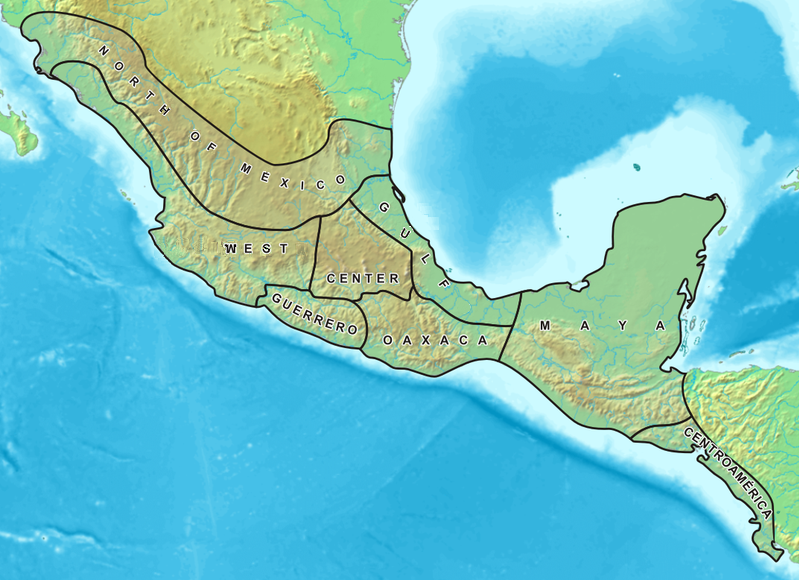
The geographical scope of Mesoamerica is vast, covering approximately 1.5 million square kilometers. Over its millennia-long history, the region supported tens of millions of people; estimates for the Aztec Empire alone at its peak range from 5 to 15 million inhabitants. The Maya civilization, at its zenith, may have supported over 10 million people across its numerous city-states. Archaeological sites number in the tens of thousands, with major centers like Teotihuacan once housing populations exceeding 100,000. The Codex Borgia, a surviving postclassic manuscript, offers a glimpse into the complex cosmology and ritual practices, with surviving examples numbering in the dozens. The agricultural output, primarily maize, beans, and squash, sustained these dense populations, with some regions achieving yields that supported specialized labor and monumental construction projects.
👥 Key People & Organizations
While no single individual 'founded' Mesoamerica as a unified entity, key figures and groups were instrumental in its development. The Olmec people, though their specific leaders are largely unknown, laid crucial cultural groundwork. Later, rulers like Pakal the Great of Palenque (reigned 615–683 CE) and Itzcoatl (ruled 1427–1440 CE), the fourth Huey Tlatoani of Tenochtitlan who formed the Triple Alliance, were pivotal in shaping their respective empires. The Maya civilization itself, a collection of independent city-states, produced numerous influential rulers and scholars whose names are now largely lost to time or known only through inscriptions. Organizations like the priesthoods and merchant guilds played critical roles in maintaining social order and transmitting knowledge. Post-conquest, figures like Bartolomé de las Casas documented and debated the fate of indigenous peoples, influencing colonial policy.
🌍 Cultural Impact & Influence
Mesoamerica's cultural legacy is immense and continues to resonate globally. The domestication and cultivation of maize fundamentally altered global agriculture and diets, becoming a staple food worldwide. The Maya's advancements in mathematics, astronomy, and calendrics remain subjects of fascination and study, influencing modern understandings of ancient science. Their intricate art and architecture continue to inspire awe, with sites like Chichen Itza and Tulum drawing millions of tourists annually. The Aztec codices, such as the Codex Mendoza, provide invaluable insights into their history, religion, and social structure, influencing fields from anthropology to art history. The concept of the Mesoamerican ballgame, played for centuries, has left an indelible mark on the region's cultural identity, with modern descendants still practicing variations of the sport. The enduring presence of indigenous languages and traditions, spoken by millions today, is a testament to the resilience of Mesoamerican culture.
⚡ Current State & Latest Developments
In the 21st century, Mesoamerica remains a dynamic region where ancient heritage intersects with modern life. Archaeological research continues to uncover new sites and refine our understanding of past civilizations, with ongoing excavations at places like El Mirador revealing even earlier monumental constructions. The descendants of the ancient peoples, speaking dozens of distinct languages, actively work to preserve their cultural traditions and languages, often facing challenges related to economic development and political representation. The tourism industry, centered around iconic sites like Teotihuacan and Copan, is a significant economic driver for many communities, though it also raises concerns about preservation and cultural commodification. Efforts to decipher previously untranslatable glyphs from various Mesoamerican scripts, such as those found in the Dresden Codex, are ongoing, promising new revelations about ancient thought and history. The region is also a focal point for studies on climate change impacts, given its historical reliance on agriculture and water management systems.
🤔 Controversies & Debates
The very definition of Mesoamerica is a subject of ongoing scholarly debate, particularly regarding its precise boundaries and the degree of cultural homogeneity versus diversity. The extent to which certain traits, like the calendar or writing systems, were independently invented or diffused across the region is a persistent question. The nature of political organization, especially the transition from decentralized city-states to empires like that of the Aztec, is debated, with varying interpretations of the extent of imperial control and tribute extraction. The causes of the Classic Maya collapse (c. 800–900 CE) remain a major controversy, with theories ranging from environmental degradation and drought to warfare and social upheaval, often considered a combination of factors. The interpretation of iconography and religious symbolism in art and texts, such as those found in the Codex Laud, also presents challenges, with scholars often disagreeing on the precise meanings and functions of deities and rituals.
🔮 Future Outlook & Predictions
The future of Mesoamerica will likely be shaped by the interplay of its rich past and pressing contemporary issues. Continued archaeological discoveries, aided by technologies like LiDAR, promise to reveal previously unknown settlements and expand our understanding of ancient urbanism and population densities. The preservation of indigenous languages and cultural practices will remain a critical focus, with potential for greater integration into national education systems and increased global recognition. Climate change poses a significant threat to the region's agricultural base and water resources, necessitating innovative adaptation strategies drawing on traditional ecological knowledge. The ongoing study of Mesoamerican mathematics and astronomy may yet yield further insights into ancient scientific thought, potentially influencing contemporary fields. Furthermore, the region's historical model
Key Facts
- Category
- history
- Type
- topic